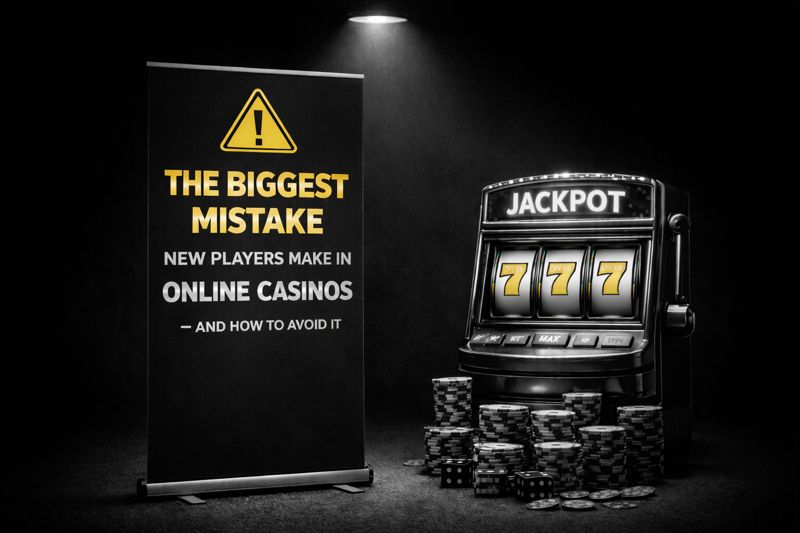



Biggest Mistake New Players Make in Online Casinos
The biggest mistake is simple: treating online casinos like a way to make money, instead of a way to spend money on entertainment with risk. From that one expectation, most costly decisions follow.
• Casinos are built with a house edge. Over time, the math wins.
• “Smart play” can reduce bad decisions, but it doesn’t reliably beat the edge long-term.
• The fix is not a secret strategy — it’s structure: budget, time limit, and emotional stop rules.
• Casinos are built with a house edge. Over time, the math wins.
• “Smart play” can reduce bad decisions, but it doesn’t reliably beat the edge long-term.
• The fix is not a secret strategy — it’s structure: budget, time limit, and emotional stop rules.
The core misconception: “If I play smart, I can beat this quickly”
Beginners rarely arrive thinking, “I want to lose money.” They think:
• “If I pick the right games, I can build a bankroll.”
• “If I’m disciplined, I’ll turn this bonus into profit.”
• “I’ll grab a quick win and cash out.”
The unspoken idea is: “If I’m smart enough, I can beat it.” But every licensed casino game is designed with a house edge. Over time, that edge wins. Your goal is not to “solve” the game — it’s to control how you interact with it.
How this mistake shows up in real behaviour
Once the “I can beat this” story is in your head, your choices shift without you noticing:
• Raising stakes after small wins (“I’m up, so now I can go bigger”).
• Chasing losses (“It’s been cold — it has to turn soon”).
• Stretching sessions (a “quick 30 minutes” becomes three hours).
• Stacking promos blindly without checking max bet rules, restricted games, or wagering terms.
• Ignoring bankroll/time limits because it feels like “grinding,” not paying for spins.
Why this mindset leads to heavy losses
Online casinos are built to be fast, convenient, and emotional — rapid rounds, constant availability, and feedback designed to keep you engaged.
Speed multiplies emotion. Wins and losses land quickly, your mood swings quickly, and you react instead of thinking.
Emotion kills discipline. Stake sizing becomes reactive, losses feel personal, and wins start to feel like “proof,” even when outcomes are still just variance inside RTP.
The fix isn’t a secret strategy. It’s structure.
There’s no system that reliably beats house edge long-term. What you can control is how you play: budget, time, and rules that stay valid even when your mood changes.
Before you play: set the structure
1) Decide how much you’re willing to lose (honestly)
Use money that does not affect rent, bills, food, or savings. If it’s gone, the session ends. No “one more deposit.”
2) Decide how long you’ll play
Set a timer. Longer sessions mean more rounds — and more house edge applied.
3) Accept that losing it all is a realistic outcome
If losing the budget feels painful, the budget is too high. If you can shrug and treat it as entertainment spend, you’re closer to the right number.
During the session: rules that survive pressure
Don’t raise stakes just because you’re emotional
• Not after a win (“now I can go bigger”).
• Not after a losing streak (“it has to hit soon”).
Don’t try to “repair” a bad session
If you’re down and annoyed, the session is already spoiled. Bigger bets don’t fix it — they speed up the damage.
Don’t chase a specific balance target
“I’ll stop when I’m back to my deposit” sounds disciplined, but it often drags you into extra spins and frustration.
When things go badly: the one move that works
If you’re redepositing to “get even,” feeling tense/irritated, or spinning just to see “what happens,” the correct move is boring and effective:
Stop the session. Walk away. Do something else.
You can play another day with a fresh mood and a new budget. You cannot undo a tilt session once it starts.
Beginner checklist (save this)
• I understand casinos are entertainment, not income.
• I only play with money I can afford to lose.
• I set a fixed budget and time limit before I start.
• I don’t increase stakes just because I’m winning or losing.
• If I’m chasing or not enjoying it, I stop.
Related guides
Prefer visual navigation? Here are the same related guides in a compact grid.

Bottom line
The biggest beginner mistake isn’t choosing the “wrong” game. It’s the story: “This is my chance to make money.”
Online casinos are fast, emotional, and built with a house edge. Treat them like income and that combination punishes you. Treat them like paid entertainment with risk, add structure, and you keep control of what actually matters: how much time and money you’re willing to spend.